RAYLEIGH WAVES TOMOGRAPHY OF NORTH AMERICA
This is a short and non exhaustive description of what I have done so far, it will give you an idea of where I am!! Just give me any comments, questions, disagrements or suggestions. See you soon!
to see everything the best way, put your caracter font on 18 (as you see I'm not an internet expert!!!! yet??)
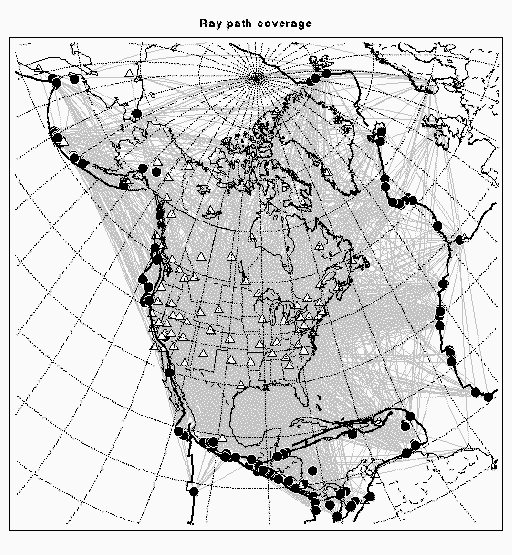
This is the ray path coverage obtained with 1641 seismograms. 133 events have been recorded by 89 stations between 1995 and 1998. Only data containing information between 40 and 150 seconds are used. This is important to get the same path coverage for each inversion.
(the figures are 'clickable')
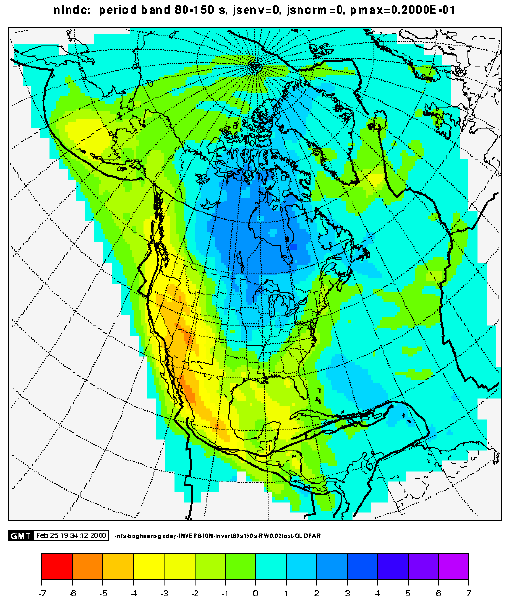
Phase velocity map for the period band 80 to 150 seconds. A damping parameter is applied to obtain the model. We have performed a non linear inversion, first for the normalized envelopes, second for the real waveforms. Each time, 10 iterations are used. There are 48 grid points in latitude and 56 in longitude.
This model is used as input model for the following period band.
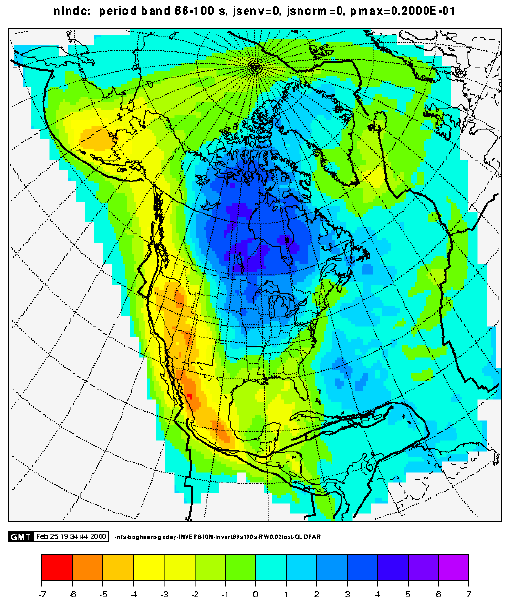
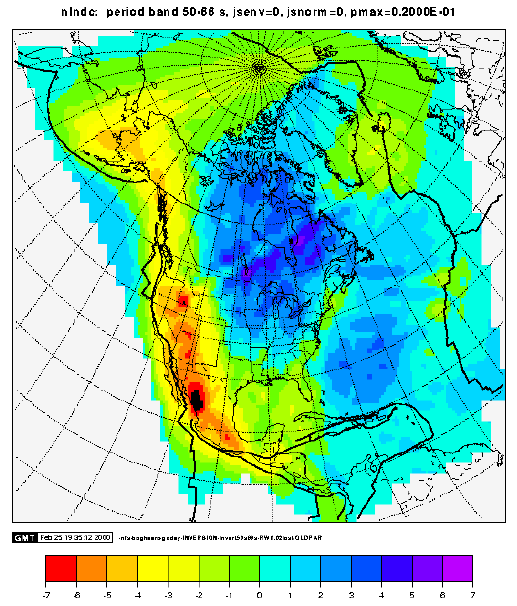
Phase velocity maps for 66 to 100seconds and 50 to 66 seconds.
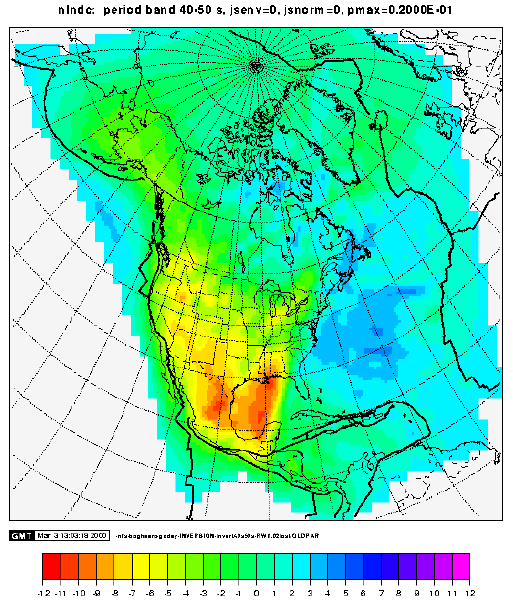
Phase velocity map for 40 to 50 seconds. The color palette is different from the one used before (something I have to fix!).
We are not sure, this period band can be resolved. The first overtone may interfere with the fundamental mode. The damping parameter should probably be increased for that last period band.
RESOLUTION TESTS
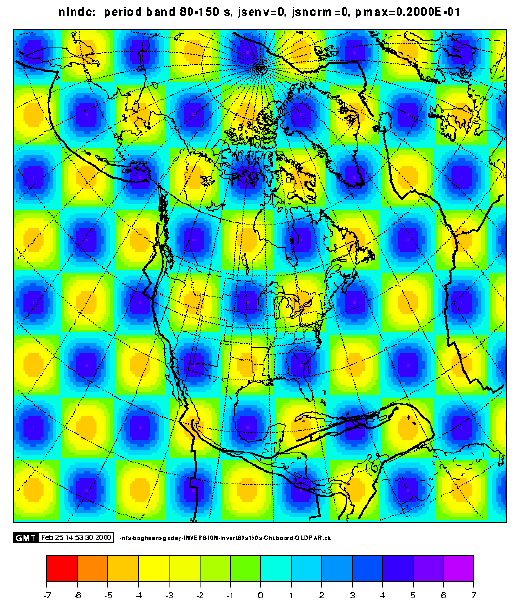
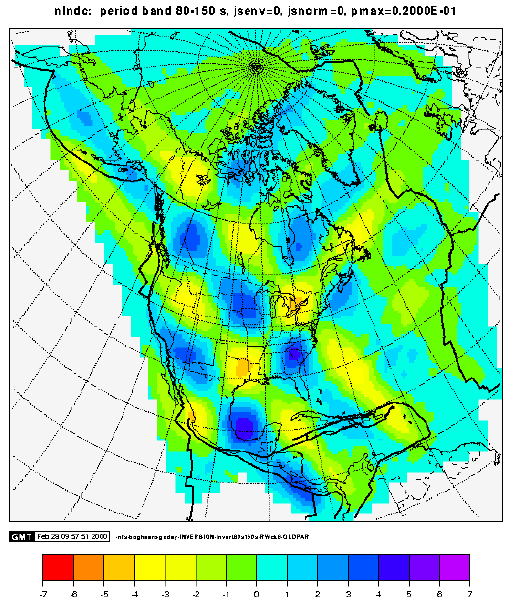
On the left is the input checkboard test. The model retrieved after non linear inversion is depicted on the right. The parameters used here are identical to the ones of the previously shown results.
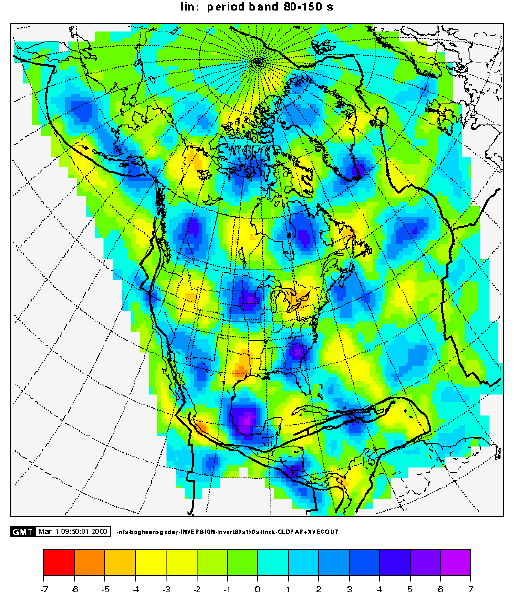
The first idea in the tomographic study was to perform a linear inversion which takes into account surface waves scattering. This method can be applied only if the input model is already representative of the earth structure. In our case, the data misfit reduction does not seem to be good enough to perform the linear step. This is mainly true for large frequency (40 to 50seconds).
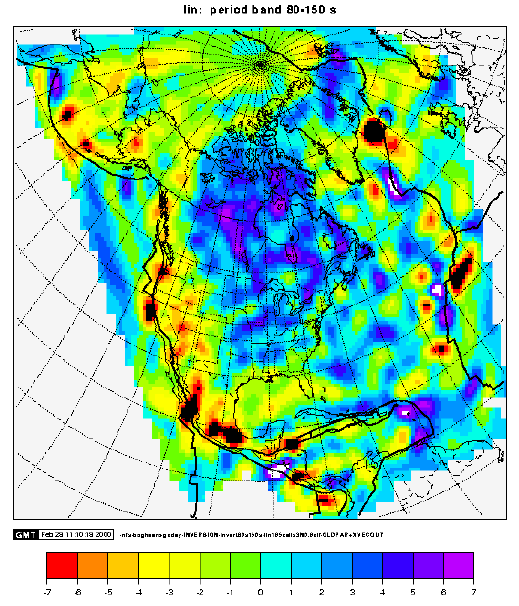
I have anyway run some linear inversion for 80 to 150 seconds where the data fit is of the order of 75%. On the left is the model obtained after a linear inversion (Born inversion, Snieder, J.G.R, 93, 12,055-12,080, 1988). On the right is the resolution pattern obtained with the same parameters after linear inversion. The results are obviously better after linear inversion for the amplitude mainly. Further on, I will try to implement that step into the tomographic work.
Masters, G., Laske, G. and Gilbert, F., Matrix autoregressive analysis of free-oscillation coupling and splitting. Geophys. J. Int. (Knopoff Festschrift), 143, 478-489, 2000. pdf Masters, G., Laske, G. and Gilbert, F., Matrix autoregressive analysis of free-oscillation coupling and splitting. Geophys. J. Int. (Knopoff Festschrift), 143, 478-489, 2000. pdf